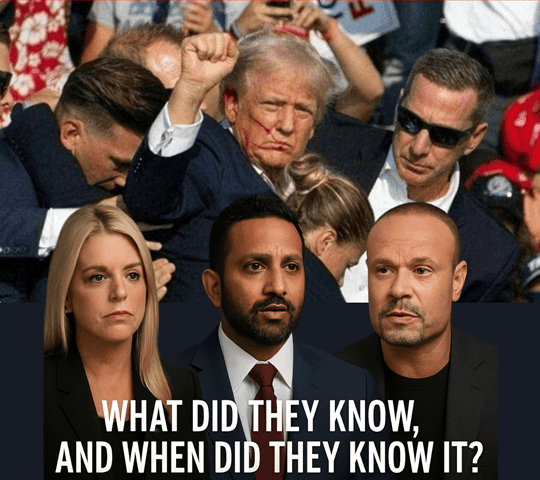
When Tucker Carlson dropped a polished, 34-minute “just asking” video exploring an assassin’s social-media breadcrumbs surrounding the attempted attack on former President Donald Trump, he reignited a national firestorm. The video didn’t present new forensic findings or classified revelations; it did highlight online evidence, public posts, and digital timelines that Carlson argues were either overlooked or never addressed by the Department of Justice, the FBI, or federal prosecutors. And that vacuum has fueled public suspicion, political argument, and questionable commentary from figures like Pam Bondi, Kash Patel, and Dan Bongino.
Below, we break down why this video hit such a nerve, and what it means for the conversation around transparency and government accountability.
The Video That Sparked a New Wave of Questions
Carlson’s production goes beyond a typical monologue. High-definition edits, clipped timelines, and on-screen visual receipts give it a mini-documentary feel. He outlines what he frames as unanswered questions about social media activity before and during the assassination attempt on Donald Trump, including posts that circulated widely among online communities but were never referenced in official briefings.
The core of Carlson’s argument isn’t that he has the definitive narrative; it’s that the government hasn’t provided one that addresses all publicly visible digital data. That distinction has resonated with viewers who already feel starved for clarity.
DOJ and FBI in the Spotlight: Silence or Strategy?
One of the central tensions in the video is the federal government’s limited public disclosure. Carlson suggests that despite repeated requests from journalists, lawyers, and congressional members, certain items of online evidence remained unacknowledged.
Federal agencies often remain silent during ongoing investigations, which may explain the gap. But in the hyper-charged atmosphere surrounding an attack on a political figure, silence often becomes its own headline.
For critics like Bongino and Patel, both deeply familiar with federal processes, the nondisclosure raises alarms about communication breakdowns at best, or institutional defensiveness at worst.
Pam Bondi’s Legal Lens: Transparency vs. Procedure
Former Florida Attorney General Pam Bondi offers a legal perspective: investigations must follow the rules, evidence must be validated, and agencies rarely move at the speed the public demands.
But even Bondi acknowledges that the public narrative vacuum is fueling unnecessary speculation. Her take: if the evidence is benign, release it. If it isn’t, explain why it’s being withheld.
Is the Real Story Incompetence, Overcaution, or Something Else?
Carlson ends his video without a conclusive claim, and that’s exactly what has driven reactions. When institutions decline to fill in the blanks, creators, analysts, and commentators rush to interpret the silence.
The result is a polarized national audience wrestling with three competing explanations:
- Incompetence — Did agencies simply overlook publicly available social media evidence?
- Caution — Is this just the slow grind of a complex federal case?
- Conspiracy — Are key details being withheld for reasons that have not been publicly disclosed?
The truth may be far less dramatic, or far more complicated, than any of these options. But the hunger for answers remains.
Bottom Line: Why This Video Matters
Regardless of one’s political position, Carlson’s video highlights a critical reality: In the digital age, the public expects real-time transparency, especially when national security is involved.
When that expectation isn’t met, independent media steps in to fill the void, sometimes responsibly, sometimes recklessly, but always effectively.
Carlson didn’t just embarrass the government; he exposed how fragile public trust has become.
We are being screwed.
— Steve

Did Tucker Carlson Just Expose a Massive Blind Spot? Inside the 34-Minute Video Turning Washington Upside Down
When Tucker Carlson dropped a polished, 34-minute “just asking” video exploring an assassin’s social-media breadcrumbs surrounding the attempted attack on former President Donald Trump, he reignited a national firestorm. The video didn’t present new forensic findings or classified revelations; it did highlight online evidence, public posts, and digital timelines that Carlson argues were either overlooked or never addressed by the Department of Justice, the FBI, or federal prosecutors. And that vacuum has fueled public suspicion, political argument, and questionable commentary from figures like Pam Bondi, Kash Patel, and Dan Bongino.
Below, we break down why this video hit such a nerve, and what it means for the conversation around transparency and government accountability.
The Video That Sparked a New Wave of Questions
Carlson’s production goes beyond a typical monologue. High-definition edits, clipped timelines, and on-screen visual receipts give it a mini-documentary feel. He outlines what he frames as unanswered questions about social media activity before and during the assassination attempt on Donald Trump, including posts that circulated widely among online communities but were never referenced in official briefings.
The core of Carlson’s argument isn’t that he has the definitive narrative; it’s that the government hasn’t provided one that addresses all publicly visible digital data. That distinction has resonated with viewers who already feel starved for clarity.
DOJ and FBI in the Spotlight: Silence or Strategy?
One of the central tensions in the video is the federal government’s limited public disclosure. Carlson suggests that despite repeated requests from journalists, lawyers, and congressional members, certain items of online evidence remained unacknowledged.
Federal agencies often remain silent during ongoing investigations, which may explain the gap. But in the hyper-charged atmosphere surrounding an attack on a political figure, silence often becomes its own headline.
For critics like Bongino and Patel, both deeply familiar with federal processes, the nondisclosure raises alarms about communication breakdowns at best, or institutional defensiveness at worst.
Pam Bondi’s Legal Lens: Transparency vs. Procedure
Former Florida Attorney General Pam Bondi offers a legal perspective: investigations must follow the rules, evidence must be validated, and agencies rarely move at the speed the public demands.
But even Bondi acknowledges that the public narrative vacuum is fueling unnecessary speculation. Her take: if the evidence is benign, release it. If it isn’t, explain why it’s being withheld.
Is the Real Story Incompetence, Overcaution, or Something Else?
Carlson ends his video without a conclusive claim, and that’s exactly what has driven reactions. When institutions decline to fill in the blanks, creators, analysts, and commentators rush to interpret the silence.
The result is a polarized national audience wrestling with three competing explanations:
The truth may be far less dramatic, or far more complicated, than any of these options. But the hunger for answers remains.
Bottom Line: Why This Video Matters
Regardless of one’s political position, Carlson’s video highlights a critical reality: In the digital age, the public expects real-time transparency, especially when national security is involved.
When that expectation isn’t met, independent media steps in to fill the void, sometimes responsibly, sometimes recklessly, but always effectively.
Carlson didn’t just embarrass the government; he exposed how fragile public trust has become.
We are being screwed.
— Steve
Thank you for visiting with us today. — Steve
“The object in life is not to be on the side of the majority, but to escape finding oneself in the ranks of the insane.” — Marcus Aurelius
“Nullius in verba”– take nobody’s word for it!
“Acta non verba” — actions not words
About Me
I have over 40 years of experience in management consulting, spanning finance, technology, media, education, and political data processing.
From sole proprietorships to Fortune 500 companies, I have turned around companies and managed their decline. All of which gives me a unique perspective on screwing and getting screwed.
Feel free to e-mail me at steve@onecitizenspeaking.com
Recent Posts ((Clickable))
Categories ((Clickable))
Archives ((Clickable))
© 2007-2026 One Citizen Speaking