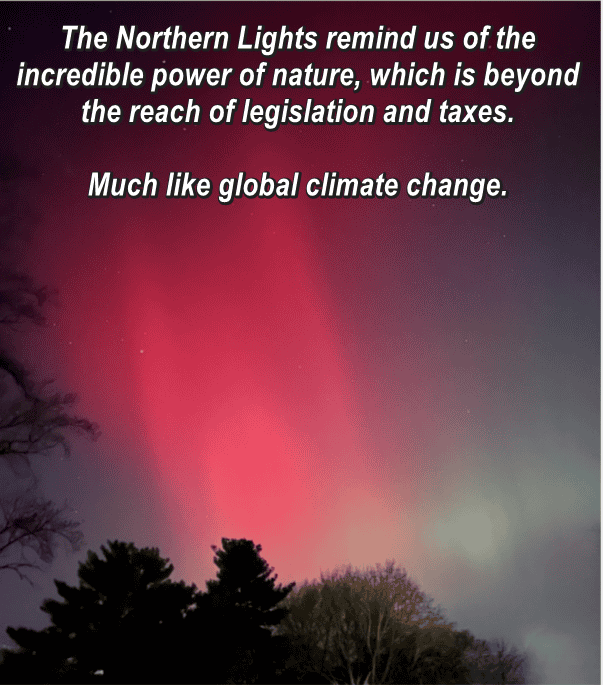
The northern lights, or aurora borealis, are dazzling light displays in the sky near the polar regions. They occur when charged particles from the Sun collide with Earth’s magnetic field and atmosphere, causing gases to glow in green, red, and purple hues.
These particles often come from solar activity, especially coronal mass ejections (CMEs). CMEs are massive bursts of solar plasma and magnetic fields released from the Sun’s corona. When directed toward Earth, they can interact with our magnetic field, amplifying auroras and causing geomagnetic storms.
A G4 geomagnetic storm is classified as “severe” on the NOAA space weather scale. Effects can include:
-
Power grid disruptions could cause blackouts.
-
Satellite and communication interference that affects GPS, radio, and the internet.
-
Radiation risks for astronauts or high-altitude flights.
-
Enhanced auroras are visible far from the poles.
While the northern lights themselves are harmless and beautiful, the underlying solar storms can pose serious technological risks on Earth, especially with modern reliance on electronics and satellites.
— Steve