The “Truth” That Sparked the Noise
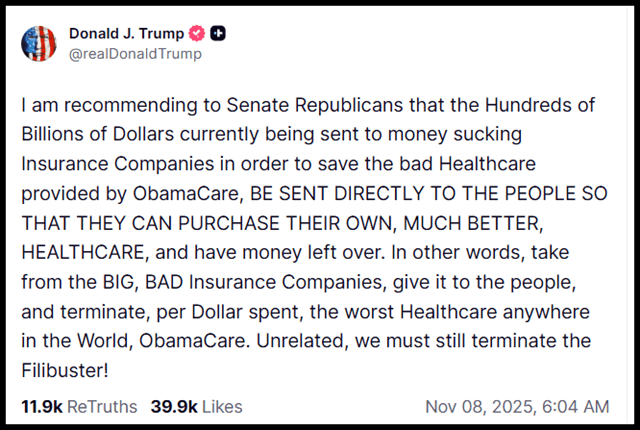
Donald Trump has never shied away from sweeping declarations, but his latest “truth” — a short, punchy social post that reads more like a slogan than a policy, once again oversimplifies a complex issue. In his words, the “Hundreds of Billions of Dollars currently being sent to money-sucking Insurance Companies” should instead be “sent directly to the people” so they can “purchase their own, much better, healthcare.”
On the surface, it sounds like a populist masterstroke: cut out the middlemen, empower individuals, and drain the healthcare swamp. But as with so many of Trump’s pronouncements, it’s easier said than done, and riddled with contradictions once you scratch beneath the surface.
The Appeal: Take from the Big, Give to the People
It’s not hard to see why Trump’s message resonates. Americans are frustrated by bloated insurance premiums, confusing networks, and red tape that defines the post-Affordable Care Act era. The idea of diverting subsidies directly to consumers, letting them buy whatever healthcare plan they choose, sounds liberating.
In theory, this would create competition, transparency, and individual choice. It taps into that quintessential American ethos of personal responsibility and free-market independence.
But in practice, this “direct-to-people” model poses massive logistical, ethical, and economic challenges.
The Reality: Healthcare Isn’t a Retail Marketplace
Healthcare isn’t a simple consumer good. It doesn’t behave like smartphones or sneakers, where market forces alone can drive quality up and prices down. Without strong regulation and collective risk-pooling, private insurers cherry-pick the healthiest individuals, leaving those with chronic conditions or disabilities priced out or uninsured altogether.
Trump’s approach assumes that individuals can navigate the complexities of actuarial pricing, coverage tiers, and long-term medical risk, something even experts struggle with. Sending cash directly to Americans and telling them to “go buy healthcare” ignores the fact that health insurance markets are fragmented, opaque, and regionally unbalanced.
In short, healthcare doesn’t work like a shopping spree.
The Hidden Consequences
If implemented, Trump’s idea would likely:
- Destabilize insurance markets, as healthier individuals exit risk pools, premiums for everyone else would spike.
- Encourage misuse of funds, some recipients might divert the money to other financial needs, leaving them uninsured.
- Reignite coverage gaps, and millions could lose protection for pre-existing conditions without regulatory safeguards.
It’s a politically charged move dressed up as reform, one that trades sustainability for shock value.
The Filibuster Distraction
Then, almost as an afterthought, Trump throws in: “Unrelated, we must still terminate the Filibuster!”
This abrupt pivot reveals the impulsive, performative nature of his political communication. Complex issues like healthcare reform can’t be reduced to 280-character soundbites and procedural threats. The mention of the filibuster doesn’t connect to the healthcare argument; it’s simply Trump doing what Trump does best: turning policy into theater.
Bottom Line: Leadership Requires More Than Rhetoric
Trump’s “take from the Big, Bad Insurance Companies and give to the people” message is catchy but hollow. It’s policy by proclamation, a populist flourish without a framework.
Healthcare reform demands hard math, bipartisan cooperation, and structural understanding. Promising voters “money left over” after buying insurance is not reform; it’s wishful thinking.
In the end, the tweet says more about Trump’s political instincts than his policy depth. It’s a reminder that in Washington, as in life, it’s always easier said than done.
We are being screwed.
— Steve

It’s Always Easier Said Than Done: The Flaws in Donald Trump’s Cursory Healthcare “Truth”
The “Truth” That Sparked the Noise
Donald Trump has never shied away from sweeping declarations, but his latest “truth” — a short, punchy social post that reads more like a slogan than a policy, once again oversimplifies a complex issue. In his words, the “Hundreds of Billions of Dollars currently being sent to money-sucking Insurance Companies” should instead be “sent directly to the people” so they can “purchase their own, much better, healthcare.”
On the surface, it sounds like a populist masterstroke: cut out the middlemen, empower individuals, and drain the healthcare swamp. But as with so many of Trump’s pronouncements, it’s easier said than done, and riddled with contradictions once you scratch beneath the surface.
The Appeal: Take from the Big, Give to the People
It’s not hard to see why Trump’s message resonates. Americans are frustrated by bloated insurance premiums, confusing networks, and red tape that defines the post-Affordable Care Act era. The idea of diverting subsidies directly to consumers, letting them buy whatever healthcare plan they choose, sounds liberating.
In theory, this would create competition, transparency, and individual choice. It taps into that quintessential American ethos of personal responsibility and free-market independence.
But in practice, this “direct-to-people” model poses massive logistical, ethical, and economic challenges.
The Reality: Healthcare Isn’t a Retail Marketplace
Healthcare isn’t a simple consumer good. It doesn’t behave like smartphones or sneakers, where market forces alone can drive quality up and prices down. Without strong regulation and collective risk-pooling, private insurers cherry-pick the healthiest individuals, leaving those with chronic conditions or disabilities priced out or uninsured altogether.
Trump’s approach assumes that individuals can navigate the complexities of actuarial pricing, coverage tiers, and long-term medical risk, something even experts struggle with. Sending cash directly to Americans and telling them to “go buy healthcare” ignores the fact that health insurance markets are fragmented, opaque, and regionally unbalanced.
In short, healthcare doesn’t work like a shopping spree.
The Hidden Consequences
If implemented, Trump’s idea would likely:
It’s a politically charged move dressed up as reform, one that trades sustainability for shock value.
The Filibuster Distraction
Then, almost as an afterthought, Trump throws in: “Unrelated, we must still terminate the Filibuster!”
This abrupt pivot reveals the impulsive, performative nature of his political communication. Complex issues like healthcare reform can’t be reduced to 280-character soundbites and procedural threats. The mention of the filibuster doesn’t connect to the healthcare argument; it’s simply Trump doing what Trump does best: turning policy into theater.
Bottom Line: Leadership Requires More Than Rhetoric
Trump’s “take from the Big, Bad Insurance Companies and give to the people” message is catchy but hollow. It’s policy by proclamation, a populist flourish without a framework.
Healthcare reform demands hard math, bipartisan cooperation, and structural understanding. Promising voters “money left over” after buying insurance is not reform; it’s wishful thinking.
In the end, the tweet says more about Trump’s political instincts than his policy depth. It’s a reminder that in Washington, as in life, it’s always easier said than done.
We are being screwed.
— Steve
Thank you for visiting with us today. — Steve
“The object in life is not to be on the side of the majority, but to escape finding oneself in the ranks of the insane.” — Marcus Aurelius
“Nullius in verba”– take nobody’s word for it!
“Acta non verba” — actions not words
About Me
I have over 40 years of experience in management consulting, spanning finance, technology, media, education, and political data processing.
From sole proprietorships to Fortune 500 companies, I have turned around companies and managed their decline. All of which gives me a unique perspective on screwing and getting screwed.
Feel free to e-mail me at steve@onecitizenspeaking.com
Recent Posts ((Clickable))
Categories ((Clickable))
Archives ((Clickable))
© 2007-2026 One Citizen Speaking