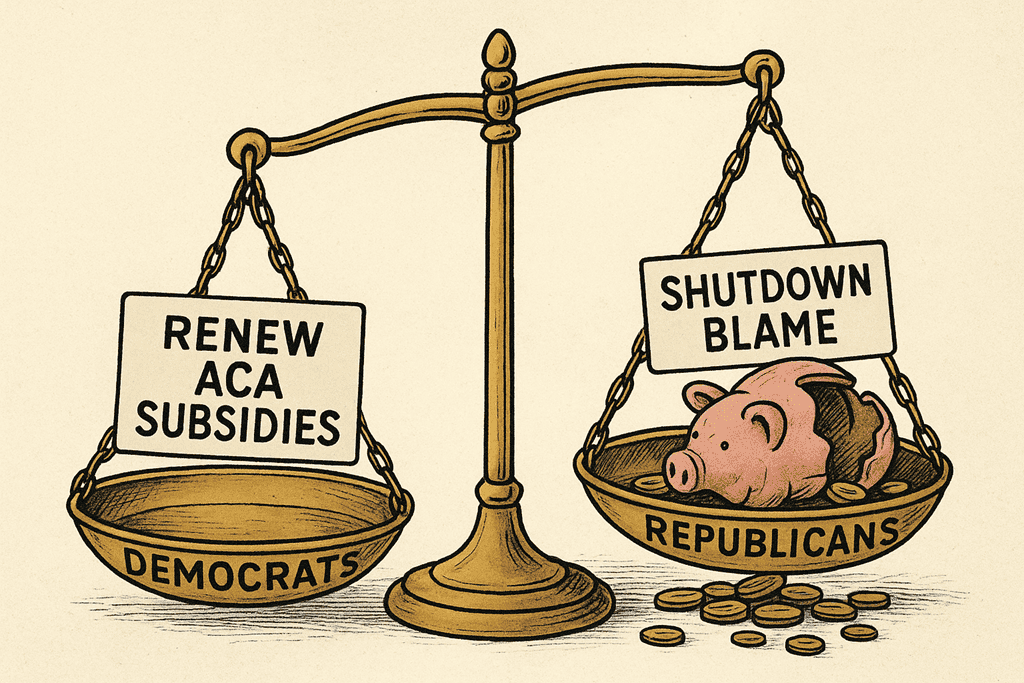
A Calculated Gamble That Paid Off
What began as a budget impasse became arguably one of the most shrewdly timed political maneuvers in recent memory. As the 2025 government shutdown dragged on, Republicans accused Democrats of reckless brinkmanship. But behind the outrage lay a quiet calculation, that the real anger of ordinary Americans wasn’t aimed at the negotiating table in Washington, but at the loss of paychecks, suspended benefits, and the looming threat of skyrocketing healthcare premiums.
Democrats framed the crisis not as partisan obstruction, but as a moral stand for working families. By refusing to pass a continuing resolution without renewal of Affordable Care Act (ACA) subsidies, they aligned themselves with the struggles of millions of voters facing real financial pain. When the dust settled on November 4, the results spoke louder than the rhetoric.
Turning Hardship Into a Campaign Message
From Virginia to New Jersey, candidates like Abigail Spanberger and Mikie Sherrill rode the wave of frustration unleashed by the shutdown. Spanberger’s campaign made the shutdown personal, connecting it to furloughed federal workers and the fragile middle class that felt Washington had forgotten them. Sherrill echoed the theme, reminding voters that without ACA subsidy renewals, health insurance costs would surge just as paychecks were frozen.
Meanwhile in New York City, Zohran Mamdani’s mayoral victory was powered by younger, economically anxious voters who saw in the shutdown a metaphor for a government indifferent to the working class. His unapologetically progressive campaign turned discontent into turnout, channeling anger into votes.
California’s Wake-Up Call
On the West Coast, California Proposition 50, a ballot measure aimed at protecting state healthcare assistance if federal funding lapsed, passed decisively. It was a clear reflection of voter sentiment. Californians understood that the fight over ACA subsidies wasn’t an inside-the-Beltway squabble; it was about real lives, real families, and the cost of simply staying insured. Proposition 50 became both a policy safeguard and a symbolic rebuke to federal dysfunction.
The Voters Remembered
By election night, it was clear that prolonging the shutdown had not punished Democrats; it had vindicated them. The strategy transformed economic anxiety into political momentum, giving voters a reason to see Democrats as defenders of working families rather than party tacticians.
In a cycle defined by uncertainty and frustration, Democrats harnessed those emotions better than their opponents. They turned government paralysis into a campaign of purpose, and the 2025 sweep proved that in politics, sometimes standing still in principle moves the nation forward.
Bottom Line: A Warning to Republicans
Republicans misread the moment, and they paid for it. By assuming the public would blame Democrats for prolonging the shutdown, they ignored the deeper voter sentiment simmering beneath the headlines: people cared less about political blame and more about lost pay, suspended benefits, and the threat of higher healthcare bills.
The 2025 special elections were a wake-up call. While Democrats stood firm and tied their stance to everyday struggles, Republicans appeared tone-deaf, defending fiscal restraint while families missed paychecks. The result? Voters saw empathy on one side and indifference on the other.
If Republicans fail to learn from this, they risk repeating the same mistake in 2026. The lesson is simple but brutal: in modern politics, economic pain speaks louder than ideology. Whoever listens to that pain — and offers relief instead of rhetoric — wins the next election.
We are so screwed.
— Steve