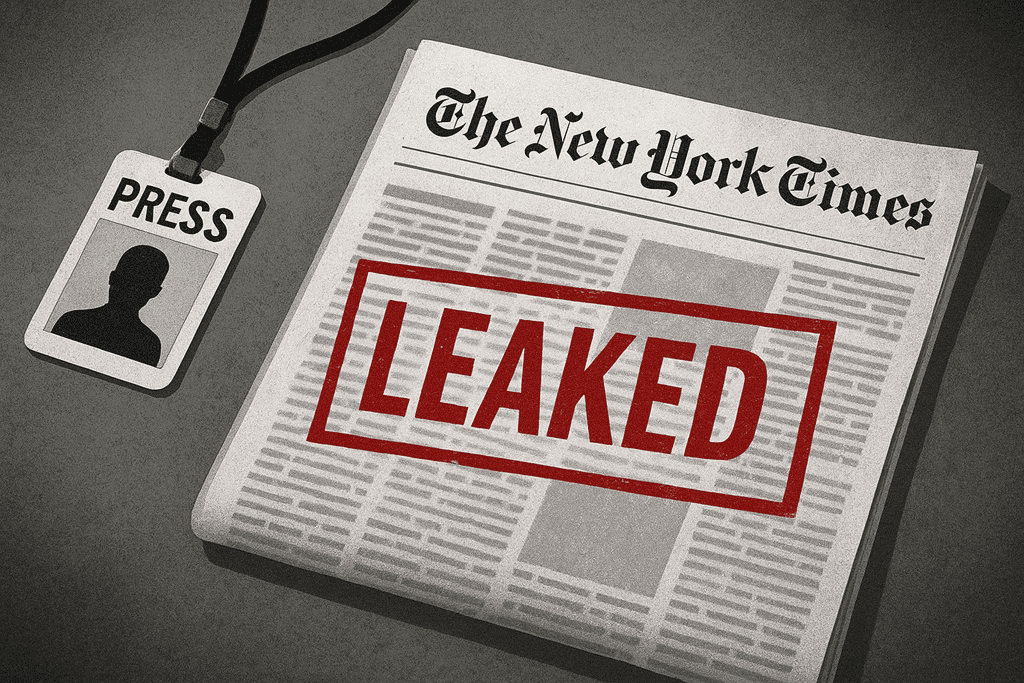
Trump Administration Authorizes Covert C.I.A. Action in Venezuela
The development comes as the U.S. military is drawing up options for President Trump to consider, including possible strikes inside the country.The Trump administration has secretly authorized the C.I.A. to conduct covert action in Venezuela, according to U.S. officials, stepping up a campaign against Nicolás Maduro, the country’s authoritarian leader. [Source: New York Times]
The Dangerous Disease of Leaking
Why can’t they keep their damn mouths shut? That’s not just a rhetorical question, it’s a cry of outrage from anyone who’s ever understood what “national security” actually means. Every week, some self-anointed “source familiar with the matter” or “official speaking on condition of anonymity” decides that their personal agenda, political vendetta, or moral vanity outweighs the safety of Americans and the integrity of covert operations.
Strategic leaks. Tactical leaks. Revenge leaks. “Resistance” leaks. They all end the same way: information spills into the open that was never meant to see daylight. And when that happens, people die. Not theoretically. Not metaphorically. Real operators, the men and women who risk everything in hostile territory, suddenly find themselves hunted because someone back home couldn’t keep quiet.
Leaks are not acts of patriotism. They are acts of betrayal.
When “Transparency” Becomes Treason
The press hides behind words like “public’s right to know” and “transparency,” but those phrases have become twisted shields for recklessness. The latest New York Times exposé, detailing the CIA’s covert authorization in Venezuela, is a masterclass in how to burn a classified operation in the name of a headline.
Let’s be clear: publishing the existence of a presidential finding, one of the most tightly guarded secrets in government, isn’t just bad judgment. It’s a security breach. Every operative in the field, every asset risking their life to collect intelligence, just got a red target painted on their back. The Venezuelan regime no longer needs to wonder about U.S. activity in the region, as the New York Times has confirmed it for them.
This wasn’t some harmless gossip or bureaucratic memo. The article directly referenced lethal authorities, troop placements, and operational intent. That’s not journalism, that’s a flashing beacon to every foreign intelligence service in the hemisphere.
The Price Paid in Blood
It’s easy to sit in a Manhattan newsroom sipping coffee and debating “press ethics.” It’s a little harder to look the families of dead operatives in the eye. Because make no mistake: every time a classified mission gets exposed, someone on the ground pays for it, with torture, imprisonment, or death.
The “pointy end of the stick,” as the special operators say, is where leaks kill. Even the faintest whisper of a covert presence can unravel a mission months or years in the making. It can send local allies running for cover or spark bloodbaths among civilians who were simply in the wrong place at the wrong time.
You don’t get to call that “responsible journalism.” You call it what it is: reckless endangerment of American lives.
The Media’s Addiction to Power
Let’s be brutally honest. Major media outlets, such as The New York Times, The Washington Post, and MSNBC, aren’t driven solely by the pursuit of truth. They’re motivated by power, the power to shape narratives, move markets, and humiliate administrations they despise.
Leaks are currency. They feed clicks, drive outrage, and give the illusion that the press still holds the moral high ground. The more “exclusive” the leak, the more prestige the outlet earns. But prestige built on classified secrets is rot disguised as righteousness.
And who holds them accountable when their “exclusive” burns an intelligence network to the ground? No one. There’s no congressional hearing for journalistic arrogance. No judge ordering the return of stolen secrets. Just awards, book deals, and the smug glow of moral superiority.
We Need Real Consequences
It’s long past time to stop pretending that leaking classified operations is some kind of public service. It’s not. It’s espionage by proxy. And when the press becomes the willing megaphone for that espionage, it ceases to be part of the solution — it becomes part of the problem.
We need accountability. Laws with teeth. If a leak directly leads to loss of life, intelligence compromise, or operational failure, the individuals responsible — both the leaker and the outlet that publishes it — should face real consequences. Not a slap on the wrist. Not a Pulitzer. Jail time.
No one is saying the press shouldn’t investigate corruption or misconduct. But there’s a chasm of difference between exposing government wrongdoing and exposing government operations. The first serves democracy. The second serves our enemies.
There Are Official Channels for Handling Classified Matters for Legitimate Whistleblowers
Let’s get one thing straight: there’s a right way and a wrong way to raise alarms about government misconduct, and dumping classified material into the public sphere is the wrong way every single time.
Legitimate whistleblowers don’t endanger covert agents, compromise missions, or hand adversaries a strategic advantage. They follow established, secure channels designed to protect both their rights and the integrity of national security operations. These channels exist precisely so that employees within the intelligence community, the military, or federal agencies can report wrongdoing without exposing sensitive information or violating the law.
There are inspectors general across the federal government, including within the Department of Justice, the CIA, and the Department of Defense, whose sole job is to handle complaints about abuse, waste, or misconduct. These offices can investigate classified matters internally, keeping secrets where they belong: inside the system, not splashed across front pages or social media.
Even Congress has secure pathways for reviewing whistleblower reports through intelligence committees. Lawmakers on those panels hold the highest security clearances and are legally bound to keep details confidential. In other words, there is a process for shining light on government wrongdoing, it just doesn’t involve calling up a reporter and spilling secrets.
When someone ignores those safeguards and leaks instead, they’re not a whistleblower. They’re a lawbreaker. They bypass oversight, damage intelligence operations, and undermine the very checks and balances they claim to defend.
Real whistleblowers act with integrity, not arrogance. They respect the system while working to fix it. They understand that the difference between accountability and anarchy is discipline — and that discipline is what keeps people alive.
Enough is Enough
At some point, we as a nation have to decide: do we want to be safe, or do we want to keep feeding the media’s addiction to secrecy porn? Because we can’t have both.
When leaks turn into headlines that compromise missions, betray allies, and embolden adversaries, we stop being a functioning republic and start being a suicide pact with microphones.
The Times can rationalize it all they want. They can talk about “careful editorial judgment” and “the public interest.” But the public interest isn’t served by giving Nicolás Maduro a cheat sheet to U.S. intelligence. It’s not served by telling the world what our covert operators are doing in the field. And it sure as hell isn’t served by getting Americans killed.
So, to every would-be leaker and every editor who thinks they’re saving democracy by betraying it — here’s a simple message: keep your damn mouth shut.
— Steve