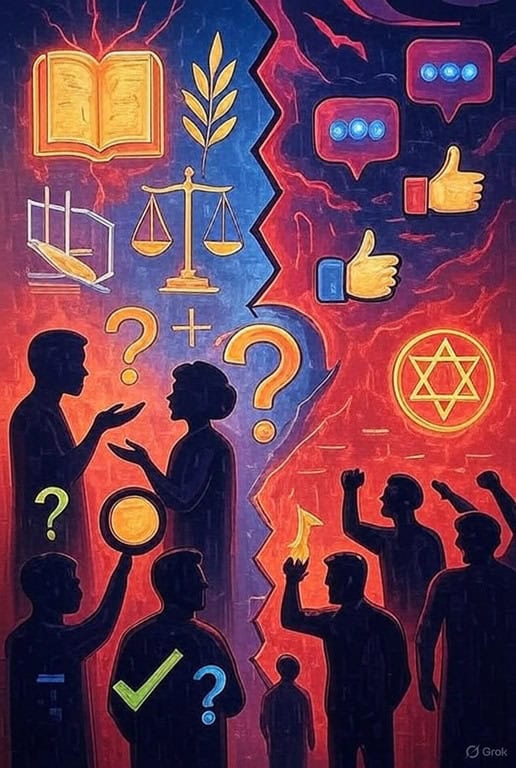
In today’s hyper-connected world, opinions are shaped less by study and more by scrolling. Few pause to question what they’re consuming, memes masquerade as facts, headlines become history, and social media takes the place of scholarship. Nowhere is this more dangerous or more evident than in the discourse surrounding Israel.
Let’s be clear: There is a crucial difference between criticism of Israeli policies and anti-Semitism. One is legitimate political discourse. The other is hatred. But in the digital space, that line has been trampled so often that people forget it ever existed.
The Internet Intifada: A War of Narratives
What we’re witnessing online isn’t simply a wave of “activism.” It’s a war of narratives, where truth is optional and virality is king. The so-called “Internet Intifada” is not about promoting justice—it’s about weaponizing half-truths, historical revisionism, and outright lies to demonize Israel, and often by extension, Jews.
Think about how quickly misinformation spreads: a sensational tweet, a video clip ripped out of context, a slogan shouted into the void. Suddenly, Israel is cast as the global villain, with no room for nuance, history, or facts. It’s a digital blood libel rebranded for a new generation.
But here’s the problem: most people aren’t knowingly anti-Semitic, they’re just uninformed. They parrot what they’ve read without questioning the source, without understanding the region, and without caring to learn. That’s ignorance. And ignorance can be cured—with facts, with history, with dialogue.
When Ignorance Becomes Dangerous
Ignorance, however, becomes anti-Semitism the moment it stops being passive and starts being aggressive. When “Free Palestine” turns into “From the river to the sea”—a call for the erasure of Israel, you’re not speaking out against injustice. You’re advocating for genocide, real ethnic cleansing.
When people start blaming “Zionists” for everything wrong in the world, from capitalism to colonialism to COVID, you’re not fighting oppression. You’re perpetuating the oldest hatred known to mankind.
When Jews are attacked in the streets of New York, London, or Paris in retaliation for the actions of a government thousands of miles away, what you’re seeing is not “resistance.” That’s anti-Semitism, plain and simple.
Criticism Is Not the Problem
Israel, like any democracy, is not above criticism. Israelis criticize their government all the time. Debate is part of the country’s DNA. Want to talk about settlements? Netanyahu? Gaza? Let’s have that conversation. But if your starting point is that Israel has no right to exist, that Jews are colonizers in their ancestral homeland, or that Zionism equals racism—you’ve left the realm of criticism and entered the territory of bigotry.
Bottom Line: Time to Think Critically
We are living in a time when moral clarity is desperately needed. This isn’t about left vs. right, Jew vs. Muslim, or East vs. West. It’s about choosing fact over fiction, truth over propaganda, and humanity over hate.
So the next time you’re about to post something, ask yourself:
- Is it true?
- Is it fair?
- Am I criticizing a government, or am I demonizing a people?
- Do I understand the history, or am I just reacting to a trending hashtag?
Because the difference between ignorance and anti-Semitism might just be the difference between retweeting and reading.
— Steve