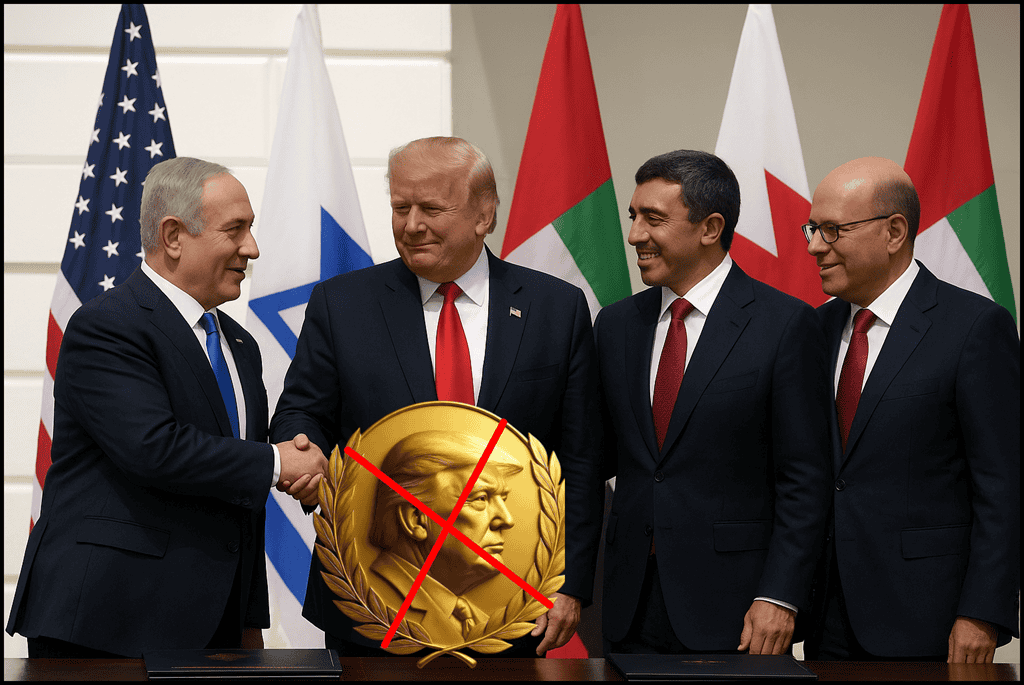
When the Abraham Accords were signed in 2020, normalizing relations between Israel, the United Arab Emirates, and Bahrain, it marked a rare diplomatic success in a region long resistant to peace efforts. The agreements reduced tensions, expanded economic cooperation, and reshaped alliances, achievements that, in many eyes, deserved global recognition. Yet the Nobel Peace Prize went elsewhere.
Timing and Political Caution
The Nobel Committee tends to move cautiously, often waiting years to assess whether peace efforts truly endure. In Trump’s case, the Abraham Accords may have been too recent to prove their long-term stability. The committee historically favors outcomes that have already matured rather than emerging breakthroughs, even when the latter show real promise. Timing, not achievement, may have been his biggest obstacle.
Media Narratives and Global Perception
The international response to Trump’s diplomacy was filtered through intense partisanship. Supporters hailed the peace deals as evidence of results-driven negotiation, while critics downplayed them as politically motivated and based on bullying rather than diplomacy. Global media coverage, especially in Europe, often emphasized controversy over accomplishment. That atmosphere of division made it easier for the Nobel Committee to sidestep a decision that might have reignited political debate and brought unwanted scrutiny to Committee members.
Lobbying and Institutional Influence
Nobel selections don’t occur in a vacuum. They are shaped by a network of politicians, non-governmental and educational institutions, advisors, scholars, and former laureates who value certain diplomatic traditions, often those emphasizing multilateral institutions and long-term engagement. Trump’s unconventional approach to foreign policy didn’t align with that model. While he built direct agreements and bypassed bureaucratic channels, the Nobel establishment tends to reward sustained diplomacy over bold disruption.
Results Versus Symbolism
In the end, the decision revealed more about how global institutions interpret peace than about who actually advances it. The Nobel Committee has often favored symbolic gestures and broad moral statements over concrete, measurable outcomes. Trump’s peace initiatives demonstrated that stability can be achieved through pragmatic negotiation and economic incentive — but the prize, as always, reflected the politics of the moment more than the permanence of results.
Bottom Line
The final decision depends a lot on how you define “deserve,” what counts as peace‐work, what evidence you accept, and how you weigh positives against negatives, not to mention consideration of the media’s reaction to the recipient and the Nobel Committee’s actions.
If one considers that President Barack Obama was awarded the Nobel Prize based on media popularity and without any significant contribution to peace or diplomacy, President Trump certainly merits the Nobel Prize. However, if one looks at Trump’s actual contribution, much of it based on the perception of bullying behavior over wussy diplomacy, one can see where the uber left-leaning Nobel Prize Committee might ignore anything Trump touched.
In the final analysis, the Committee will do what the Committee will do.
— Steve
Reference: These members are appointed by the Norwegian Parliament for six-year terms, reflecting the political composition of the parliament. The committee operates independently and is assisted by the Norwegian Nobel Institute.
Norwegian Nobel Committee Members (2025)
Jørgen Watne Frydnes – Norwegian human rights advocate, youngest-ever Chair of the Nobel Committee, and former CEO of Utøya AS.
Asle Toje – Norwegian foreign policy scholar and Deputy Leader of the Nobel Committee, with a background in international relations theory.
Anne Enger – Former Norwegian politician, leader of the Centre Party, and acting Prime Minister in 1998.
Kristin Clemet – Norwegian politician and managing director of the liberal think tank Civita, previously serving as Minister of Education and Research.
Gry Larsen – Former Norwegian Labour Party politician and current National Director for CARE Norway, focusing on humanitarian work.
Kristian Berg Harpviken – Norwegian sociologist and researcher, appointed Director of the Norwegian Nobel Institute in 2025, with expertise in peace and conflict studies.