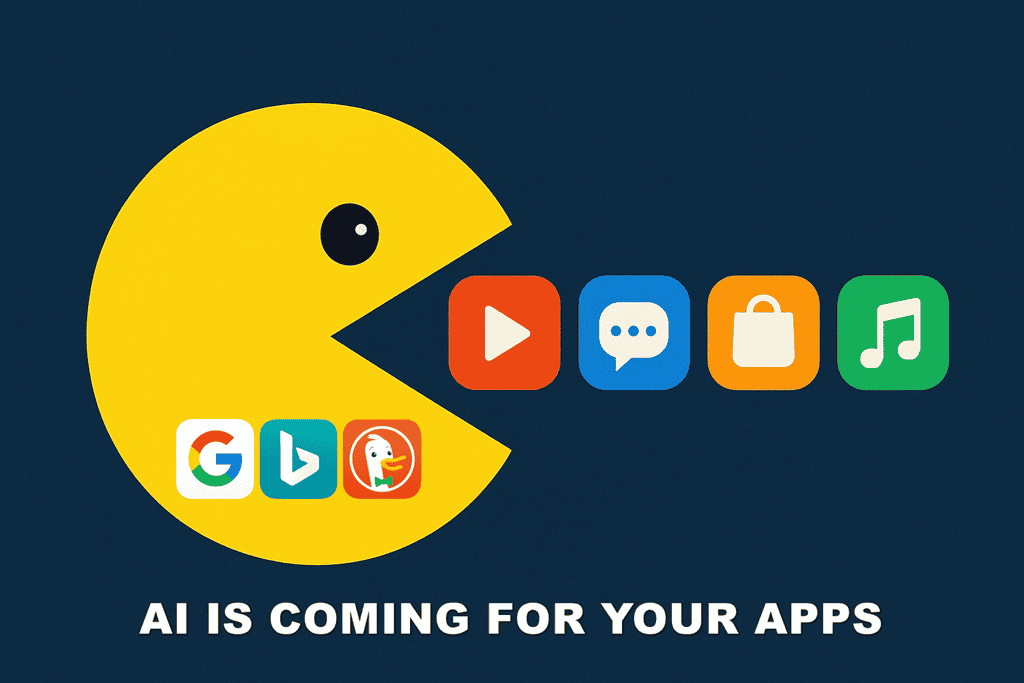
The Next Frontier: AI Eats the App Store
Artificial Intelligence is no longer just the “smart assistant” sitting on your phone; it’s about to become the app itself. The quiet revolution happening right now isn’t about smarter code or cooler user interfaces. It’s about AI taking over the entire role of your apps.
Imagine this: instead of opening multiple applications to find a restaurant, read reviews, compare prices, and make a reservation, your AI interface provides you with the final answer. No extra clicks, no extra screens, and no ads unless it decides to show them.
This isn’t speculation. It’s a trajectory.
Today’s AI models are already screen-scraping, synthesizing, and summarizing content from every corner of the web. Tomorrow, they’ll become the only layer between users and the entire internet, curating, interpreting, and deciding what you see.
Screen Scraping 2.0: When Data Stops Belonging to Apps
Screen scraping used to be a gray-hat trick, a way for developers to extract useful data from locked-down platforms. But AI has turned it into an art form.
Modern AI systems don’t just scrape; they understand. They read, digest, and reframe information into human-palatable answers. That means every API call, every line of UI text, and every pricing table can be absorbed and repurposed by AI.
If you’re running an app built on content, reviews, recipes, flight data, or even social media posts, you’re effectively training your replacement. The AI doesn’t need to host your data. It just needs to see it once.
And once it understands and reproduces your app’s core function, it no longer needs your app at all.
The New Gatekeeper: AI as the First Point of Contact
We used to think search engines were the gateway to the internet. That era is over. The next gateway is your AI assistant, your “copilot,” your “companion,” your “personal GPT.”
Soon, when you ask a question: “Book me a flight to Tokyo,” “Find the best pizza nearby,” “What’s the cheapest insurance?” your AI won’t direct you to Expedia, Yelp, or Geico. It will act like those apps itself.
It might show you a sponsored offer, maybe an ad slot that an advertiser has paid to occupy, but that’s just a temporary compromise. The longer-term evolution is clear: AI as the middleman becomes AI as the destination.
The endgame? You don’t “use” apps. You interact with one entity, and that entity decides what to show, what to buy, and what to believe.
When AI Becomes the App
This shift will be as profound as the birth of the web browser or the smartphone. The app model, thousands of siloed, branded experiences, was built on the assumption that humans would browse, tap, and compare.
AI doesn’t browse. AI decides.
So what happens when that logic applies to Spotify, Amazon, or Netflix? If your AI already knows your tastes, your habits, your mood, why open another interface? Why click through?
The only thing holding back this transformation today is trust and monetization. Once AI platforms figure out how to pay creators fairly (or at least convincingly), and how to monetize user attention without breaking ethics or antitrust laws, the walls come down fast.
When that happens, every standalone app becomes redundant — a back-end service feeding a front-end brain.
The End of the Link Economy
This also spells trouble for the broader digital ecosystem, especially publishers, marketers, and search-based platforms.
If AI gives you the perfect answer, why click anything else?
That’s the existential threat to Google Search, to content farms, to affiliate marketing, to the entire “click economy.” Traffic, once the currency of the web, will collapse. The AI won’t “send” you to sites, it’ll summarize them. It’ll synthesize your intent into a one-line answer, maybe decorated with an ad.
Links will become a relic, like phone books.
Winners, Losers, and the Coming Consolidation
The winners in this new ecosystem will be those who own the models and control the data pipelines. OpenAI, Anthropic, Google DeepMind, and whoever builds the next frontier of personal AIs will dictate not just how we interact with information, but who gets paid for it.
Losers? Any company whose value lies in presentation rather than possession. Apps built around aggregation, UI polish, or basic data retrieval are in the crosshairs.
Soon, your AI will not only provide the best answer — it will decide what “best” even means.
Bottom Line: The Inevitable
AI is not just disrupting the app economy — it’s absorbing it.
In a few years, the concept of “downloading an app” will feel as archaic as “installing a driver” or “burning a CD.” You’ll have one interface, one intelligent layer, one voice — and behind it, a shifting network of APIs and data streams, invisible and replaceable.
That’s not the future of apps. That’s the end of apps.
As we grow more dependent on technology, especially internet-connected technology, we are so screwed.
— Steve