The Myth of the Brave Comedian
Comedians love to position themselves as modern gladiators of truth, swaggering onstage, mic in hand, claiming to “say what everyone’s thinking” while taking on the sacred cows of culture. They puff out their chests about “free speech,” insisting comedy should be fearless, boundary-breaking, and untamed.
But scratch the surface, and the irony is brutal. The loudest voices defending “the right to offend” often go silent when the stakes get real; when sponsors, networks, or governments flex their power. Suddenly, that bold talk about “no censorship” turns into cautious PR statements, quiet withdrawals, and well-timed apologies.
Talk Tough, Cash the Check Quietly
The truth? Too many comics treat free speech like a stage prop. They’ll flirt with controversy when it’s safe, when it boosts clicks, sells tickets, or trends on X (formerly Twitter). But when the real heat hits, when contracts, paychecks, or platforms are on the line, they fold faster than a cheap lawn chair.
The industry rewards conformity dressed up as rebellion. The networks and streamers don’t want real risk; they want the illusion of edge. The moment a comedian’s joke crosses the “wrong” line, the PR team steps in, and the same comic who claimed “I’ll never apologize” is issuing a Notes app apology before lunch.
The Riyadh Comedy Festival: The Fine Print of “Free” Speech
Nothing reveals the hypocrisy better than the Riyadh Comedy Festival, where top international comedians happily performed under one of the most restrictive speech contracts imaginable.
Buried in the fine print were content restrictions that would make even a 1950s censor blush:
“ARTIST shall not prepare or perform any material that may be considered to degrade, defame, or bring into public disrepute, contempt, scandal, embarrassment, or ridicule:
A) The Kingdom of Saudi Arabia, including its leadership, public figures, culture, or people;
B) The Saudi royal family, legal system, or government; and
C) Any religion, religious tradition, religious figure, or religious practice.”
In other words: no politics, no religion, no culture, no critique — the entire traditional realm of stand-up comedy.
So what did they joke about? Airplane food? Jet lag? The heat? Maybe a little harmless banter about hotel minibars? Whatever it was, it wasn’t truth-telling. It was comedy declawed — laughter fenced in by royal decree.
Dave Chappelle: Comedy, Controversy, and Contradiction
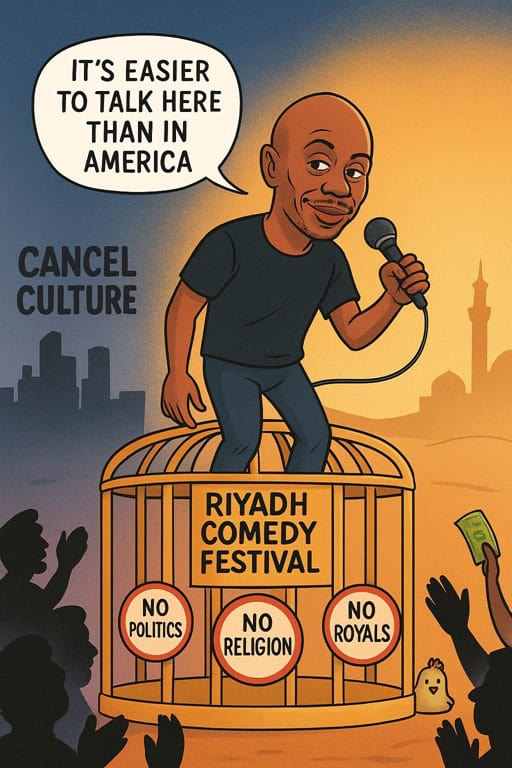
Dave Chappelle’s set at Riyadh perfectly illustrates the paradox. He directly compared freedom of speech in Saudi Arabia to the United States, making headlines for his audacity.
“Right now in America, they say that if you talk about Charlie Kirk, that you’ll get canceled. I don’t know if that’s true, but I’m gonna find out.”
He added:
“It’s easier to talk here than it is in America.”
And at the conclusion of his performance, Chappelle expressed personal concern:
“They’re going to do something to me so that I can’t say what I want to say.”
The irony is glaring. Chappelle critiqued U.S. “cancel culture” while performing under one of the strictest comedy contracts in the world, forbidden from mentioning the Saudi royal family, the government, religion, or local culture. His set became a real-time example of today’s comedy paradox: claiming bold free speech while performing safely for a paycheck.
Free Speech Until the Paycheck Stops
Here’s the uncomfortable part: real free speech comes with consequences. It’s easy to be “brave” when the crowd’s laughing. It’s much harder when the crowd boos, when advertisers pull out, or when you’re disinvited from a festival. That’s when the real measure of conviction shows.
And that’s where today’s comedy scene fails. The comedians who shout loudest about “cancel culture” are often the ones most terrified of losing the corporate ladder they’re climbing. They’re not freedom fighters, they’re freelancers managing brand risk.
The Comedy of Compliance
Comedy used to punch up, not sell out. It used to mock power, not cozy up to it. Lenny Bruce went to jail for words. George Carlin was banned from television for “indecency.” They didn’t just talk about free speech; they lived it and paid the price for it.
Now? Too many comics confuse being “edgy” with being algorithm-friendly. They rant about censorship but play it safe to keep that Netflix special, that late-night slot, that sponsor deal. They’re not speaking truth to power, they’re performing rebellion for profit.
Bottom Line: When the Curtain Falls
It’s not that comedy should always be political or provocative. But if comedians are going to keep preaching about the sanctity of free expression, they should at least mean it. You can’t claim to be a truth-teller and then crumble the second the paycheck’s threatened. That’s not courage, that’s commerce.
In the end, the real joke is on us. We keep waiting for the next great comic revolution, but all we get are more safe monologues wrapped in the language of danger. The punchline? Freedom’s for sale, and the house always wins.
I would have loved to have seen what iconic free speech advocate George Carlin would have said.
We are so screwed.
— Steve