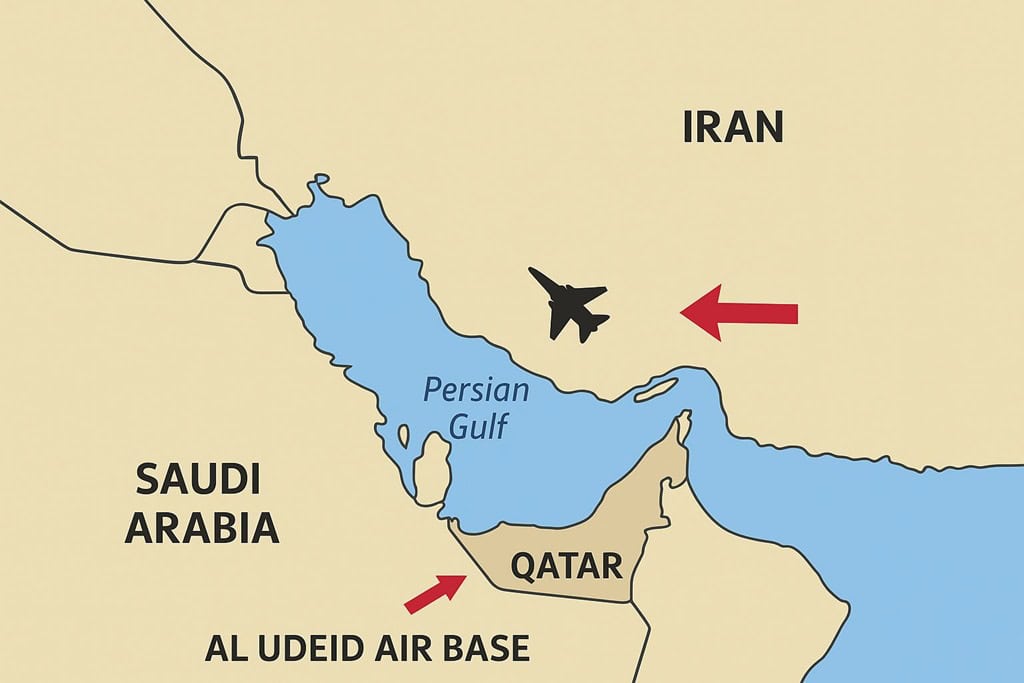
President Donald Trump’s executive order pledging to defend Qatar against external attack has sparked debate in Washington and beyond. For the first time, the United States has promised to treat an attack on the Gulf monarchy as a threat to American peace and security. But does the president actually have the power to commit U.S. troops to defend a country with a history of supporting terrorist groups and funding subversive institutions within the United States?
The answer lies in the blurry balance between presidential authority, congressional power, and America’s complicated ties to Qatar.
Trump’s Executive Order: Bold but Limited
The order states that any attack on Qatar’s territory, sovereignty, or infrastructure will be considered an attack on U.S. security. It further promises that America will respond with “all lawful and appropriate measures,” including diplomacy, economic sanctions, and military force.
This language mirrors NATO’s Article 5 security guarantees but comes without the same legal foundation. NATO’s commitments are rooted in a ratified treaty approved by the United States Congress. Trump’s order, by contrast, is a unilateral presidential directive. That means it signals intent but lacks the permanence and binding force of a treaty.
In practical terms, Trump can act immediately to defend Qatar, but the order itself does not legally bind future presidents, nor does it override Congress’s constitutional role in declaring war.
Congress Holds the War Powers
Under the U.S. Constitution, Congress—not the president—has the sole authority to declare war. The president, as Commander-in-Chief, can deploy troops and respond to emergencies; however, sustained military operations require congressional authorization.
History shows presidents often push this boundary. Truman sent U.S. forces into Korea without a formal declaration of war. More recently, Obama engaged in military operations in Libya without congressional approval. In both cases, presidents claimed executive authority while critics accused them of overreach.
Trump’s executive order on Qatar falls into this same constitutional gray area. He can send troops into harm’s way in the short term, but without Congress, a long and costly war in defense of Qatar would lack legal and political legitimacy.
Qatar: Ally, Partner, or Problem
The controversy is not just constitutional—it’s also moral and strategic. Qatar plays a double role in U.S. foreign policy.
On one side, Qatar is home to Al Udeid Air Base, the forward headquarters of U.S. Central Command, making it a vital hub for military operations in the Middle East. It also helped during the U.S. withdrawal from Afghanistan and maintains diplomatic channels with groups like the Taliban and Hamas, giving Washington indirect leverage.
On the other side, Qatar has long been accused of funding extremist groups and sheltering their leaders. Hamas officials have lived comfortably in Doha, and Qatari money has flowed to radical organizations across the region. Even Trump himself once said Qatar “has historically been a funder of terrorism at a very high level.” Its state-funded broadcaster, Al Jazeera, has been accused of spreading anti-American and anti-Semitic propaganda.
This makes Qatar a highly unusual recipient of U.S. security guarantees. Unlike NATO allies or Asian partners such as Japan and South Korea, Qatar has often worked against U.S. interests even while hosting American forces.
What Does the U.S. Gain?
If Qatar’s reputation is so controversial, why defend it at all? The answer is pragmatic. For decades, the U.S. has relied on Qatar for its geographic position and infrastructure. Al Udeid Air Base houses thousands of American troops, advanced aircraft, and critical command-and-control systems for operations across the Middle East. Without it, the U.S. would face higher costs and fewer strategic options.
Economically, Qatar has invested heavily in American industries and pledged over $1 trillion in recent trade and energy deals. Trump has leaned on those commitments as evidence of Qatar’s value to the U.S. economy.
Diplomatically, Qatar’s ability to engage with groups that Washington cannot directly address makes it a valuable asset. Whether mediating with Hamas, the Taliban, or Iran, Qatar acts as a middleman. For Trump, securing Qatar means securing a channel to groups the U.S. cannot ignore.
The Impact on Iran
Defending Qatar is also about sending a message to Iran. Tensions with Tehran remain high after years of nuclear brinkmanship and proxy conflicts across the region. By pledging to defend Qatar, Trump effectively extends an American shield over a Gulf monarchy just across the water from Iran.
This complicates Iran’s strategic calculus. Striking Qatar now risks not just a local skirmish but a confrontation with the U.S. military. The order could deter Iranian aggression while reinforcing American dominance in the Persian Gulf.
At the same time, the move may provoke Tehran. Iran has already targeted Gulf states in response to U.S. sanctions and Israeli pressure. If it views the U.S. guarantee as an encirclement strategy, tensions could escalate further.
Why Now?
Timing is critical. The executive order came days after an Israeli airstrike in Doha killed Hamas leaders. Qatar demanded reassurance, and Trump delivered. The pledge serves as damage control to prevent further escalation of the Israeli-Qatari conflict while preserving Doha’s cooperation in mediating ceasefire talks.
It also comes as Saudi Arabia struck a defense pact with Pakistan, putting Riyadh under Islamabad’s nuclear umbrella. By moving closer to Qatar, Trump may be recalibrating America’s Gulf partnerships, tilting toward the state most willing to align with U.S. economic and security goals, even if it remains a controversial move.
Ultimately, the timing aligns with Trump’s political brand. Presenting himself as a dealmaker who can secure allies and prevent escalation, he chose speed and surprise over lengthy congressional debate.
A Risky Signal in the Middle East
Trump’s move reassures Doha but risks entangling the U.S. in conflicts where public support is shaky. Critics already question why American soldiers should risk their lives for a monarchy accused of financing terrorism.
By granting Qatar what Saudi Arabia has long sought, Trump may reshape Gulf dynamics in unpredictable ways. The order reflects both necessity—America needs Qatar’s base—and gamble—America may end up defending a partner that has not always acted like one.
Bottom Line: A Constitutional and Strategic Test
Trump’s pledge to defend Qatar highlights the tension at the heart of U.S. foreign policy. Presidents often expand their power in the name of security, but the Constitution draws clear lines that only Congress can cross. And when the ally in question has funded groups hostile to America, the political case becomes even harder to make.
Ultimately, Trump can act, but not without limitations. His executive order may reassure Qatar today, but its real test will come if American soldiers are asked to fight for a partner that many Americans see as more foe than friend.
We are so screwed when we trust an alien culture that plays both sides of the geopolitical game..
— Steve