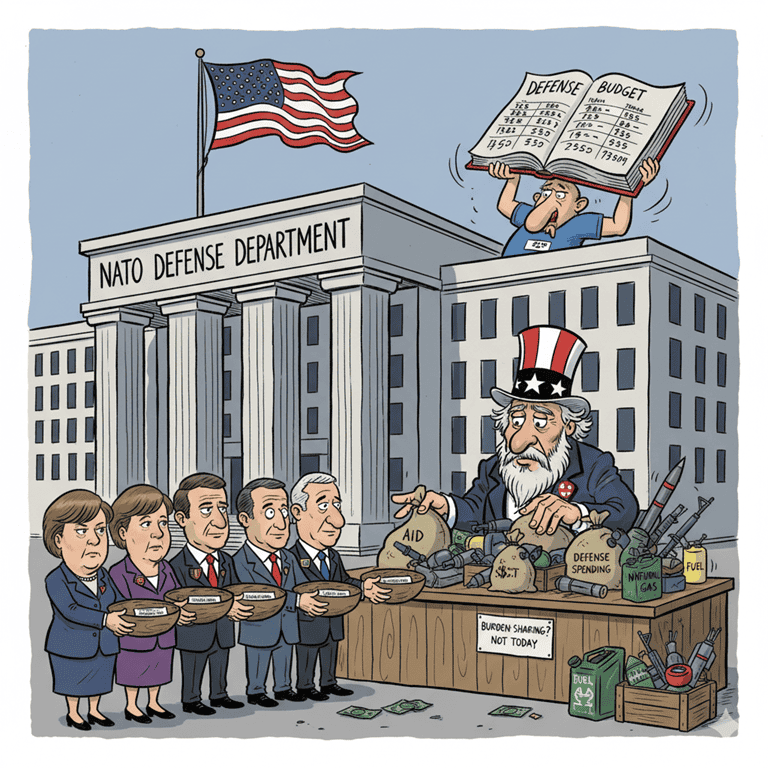
For decades, the North Atlantic Treaty Organization (NATO) has been praised as the shield of the West. But a closer look reveals something far less noble. NATO has largely become a military welfare program, a system where the United States shoulders most of the costs and responsibilities while second-rate countries free-ride on the American taxpayer.
The U.S. as NATO’s Primary Bankroller
NATO was founded in 1949 with the idea that its members would collectively contribute to mutual defense. In practice, however, the alliance has become dominated by U.S. spending. Washington contributes roughly 70% of NATO’s total defense expenditures.
While the U.S. spends well above 3% of GDP on defense, most European countries consistently fail to meet the agreed 2% target. Nations like Germany, Spain, and Italy often hover around 1.3% or less, all while lecturing Washington on global diplomacy. This makes NATO less of a mutual defense pact and more of a welfare arrangement where America foots the bill.
Europe’s Dependence on American Muscle
Despite being wealthy and industrialized, European NATO members rely on U.S. hardware, intelligence, and manpower. When the Libya campaign unfolded in 2011, European nations quickly ran out of munitions within weeks. The United States had to step in and provide the precision weapons, refueling aircraft, and logistical backbone to sustain the mission.
The same story repeats in Eastern Europe. NATO countries bordering Russia talk tough, but their militaries are underfunded and hollow. Poland and the Baltic states have made efforts to modernize, but larger powers, such as Germany, continue to lag behind. The result: Europe engages in politics while America provides security guarantees.
The Welfare State Mentality
NATO mirrors the problems of the welfare state. Just as welfare programs can disincentivize individuals from working harder, NATO disincentivizes nations from taking responsibility for their own defense. Why should Germany or Italy invest in tanks, fighter jets, or nuclear deterrence when the Pentagon already does it for them?
This mentality creates a dependency that undermines the very sovereignty NATO claims to protect. Instead of forging robust national defense policies, member states outsource their safety to Washington, knowing full well that the U.S. will not allow a Russian incursion to go unanswered.
Second-Rate Militaries in Practice
It is no exaggeration to say that many NATO countries field second-rate militaries. Germany, once a military powerhouse, is now infamous for broken tanks, grounded aircraft, and ammunition shortages. The Bundeswehr has been reduced to a bureaucratic force incapable of sustained combat.
Similarly, Italy’s armed forces are plagued with outdated equipment, while Spain has struggled to fund even basic training. Even Britain, supposedly the strongest European NATO member, has faced deep cuts and readiness issues. Without American involvement, NATO’s collective strength looks alarmingly thin.
Burden-Sharing Rhetoric vs. Reality
NATO leaders often talk about “burden-sharing,” but reality shows the opposite. When former U.S. presidents from Eisenhower to Trump demanded that Europe pay more, European leaders bristled but did little. At summits, promises are made, communiqués are signed, and yet the budgets remain inadequate.
This is not burden-sharing; it is burden-shifting. American taxpayers subsidize the defense of wealthy European nations who prefer to spend on welfare programs, green energy subsidies, and bureaucratic expansion. NATO has become a subsidy program for Europe’s lifestyle choices, rather than a true alliance of equals.
Is NATO Still Relevant?
Proponents argue that NATO is vital for countering Russian aggression, and recent events in Ukraine highlight the need for Western unity. Yet the problem remains: “unity” is meaningless if only one side is paying the costs. A genuine alliance would require European nations to carry their weight, not lean on American taxpayers for protection.
If NATO is to survive, it must reform into an organization where every member contributes equally in proportion to their capabilities. Otherwise, it is time to admit what NATO has become — a military welfare program that benefits second-rate countries at America’s expense.
Turkey: NATO’s Two-Faced Member
Turkey is the clearest example of NATO’s duplicity problem. On paper, Ankara is a key ally, strategically positioned at the crossroads of Europe and the Middle East. In practice, it plays both sides, acting as a duplicitous, two-faced bad actor. Turkey has purchased Russian S-400 missile systems in open defiance of NATO security standards, undermining alliance unity. At the same time, it exploits NATO membership to shield itself from criticism while cracking down on dissent at home and threatening its neighbors. By harboring Islamist ambitions and cozying up to Moscow, Turkey exposes the contradictions at the heart of NATO: an alliance that claims to defend democracy but includes members who work against it.
Bottom Line: Time for a Reckoning
NATO was once a bulwark against Soviet expansion, but today it risks becoming a bloated bureaucracy that props up weak militaries. The United States cannot indefinitely fund Europe’s security while its own borders, debt, and strategic interests suffer neglect.
A real reckoning is overdue. Either NATO transforms into a balanced, reciprocal defense pact, or the U.S. should rethink its role entirely. America was never meant to be the permanent welfare provider for second-rate countries unwilling to defend themselves.
We are so screwed.
— Steve