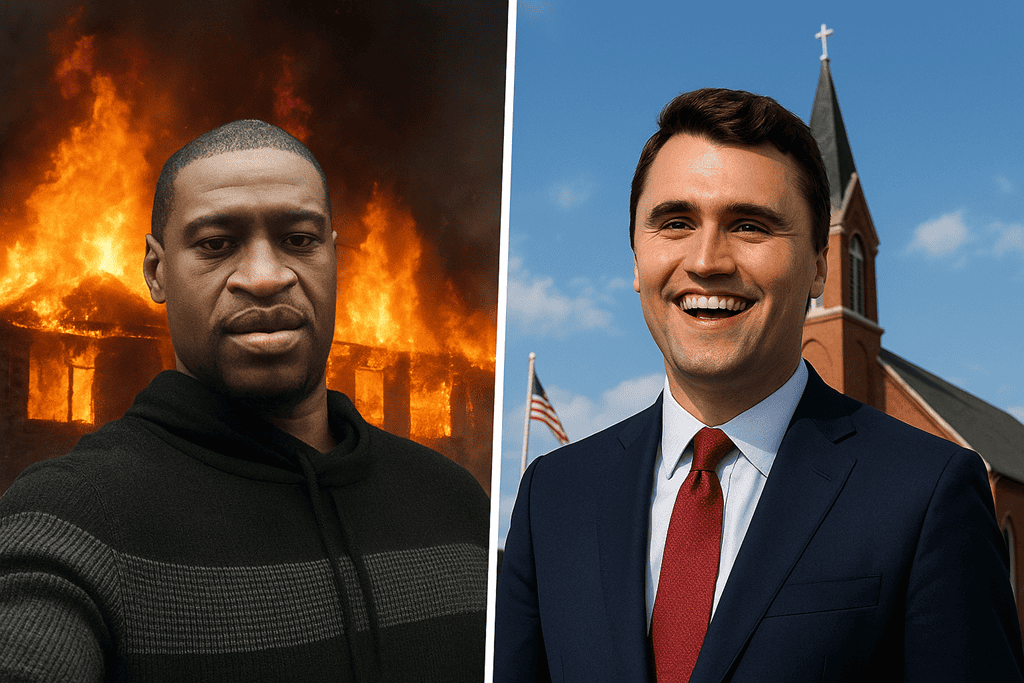
Every political movement has its defining moment. These are more than headlines, they are symbols that shape how an entire generation sees the world. For the left, it was a celebration of the thuggish criminal George Floyd. For the right, a polite, worshipful Charlie Kirk is emerging as a defining figure.
The contrast is stark: one rooted in rage, grievance, and destruction; the other in faith, joy, and construction. Understanding these two moments is essential to understanding America’s cultural crossroads.
The George Floyd Uprising: Chaos as Creed
George Floyd’s death in May 2020 was regretful, but the movement it sparked quickly became catastrophic. What began as protests against police misconduct devolved into nationwide riots and arson. Police stations were stormed. Small businesses burned. Entire neighborhoods were abandoned by commerce and safety.
The fallout was real and measurable: billions in property damage, skyrocketing crime rates, and shattered trust in urban institutions. Homicide and violent crime surged in cities across the nation. Families fled, businesses closed, and communities that had once thrived became ghost towns.
Floyd himself became a secular saint. His image adorned murals globally. His name was chanted like scripture. But the consequences of that “reverence” were ignored: burning cities, decimated communities, and a culture of grievance where anger became a badge of honor.
This was a movement built on destruction, not construction. Rage replaced reason. Violence became performance art. The George Floyd moment revealed the progressive communist democrat left at its most raw: a political culture that values symbolism over substance, destruction over renewal.
The Charlie Kirk Surge: Energy and Joy as Weapons
Contrast that with the right’s emerging defining moment. Charlie Kirk and Turning Point USA are rallying young Americans, not around grief or destruction, but around faith, purpose, and patriotic pride.
Packed arenas, hands raised in prayer, music swelling as students pledge allegiance to principles rather than destruction. The energy is electric, but constructive. It fosters community, leadership, and a sense of belonging. Kirk’s followers aren’t fleeing neighborhoods, they are building networks, student groups, and initiatives to promote conservative ideas in schools and communities.
Where Floyd became a martyr of grievance, Kirk has become a beacon of vigor, optimism, and renewal. This is joy as a movement. This is faith and culture fused with politics, creating momentum that doesn’t destroy—it energizes.
Violence vs. Worshipful Joy
The contrast is unmistakable:
Left: cities burning, chaos glorified, grievance worshiped.
Right: music, prayer, and celebration of America as a force for good.
One movement feeds resentment, guilt, and self-pity. The other feeds resilience, energy, and hope. One tears down; the other builds up. One looks backward in anger; the other looks forward in optimism.
The Aftershocks: Crime, Collapse, and Cultural Guilt
The consequences of the Floyd moment go beyond symbolism. Major cities saw homicide rates spike 30–60%. Police forces were demoralized and under attack. Small businesses, the lifeblood of neighborhoods, closed permanently. Cultural institutions were pressured into adopting performative “anti-racist” policies, prioritizing optics over outcomes.
Meanwhile, on the right, the Kirk surge builds tangible institutions, including student networks, conferences, mentorship programs, and political engagement, which channel youthful energy into constructive action. Where the left left ashes, the right is planting seeds for a movement that can endure generations.
Two Visions of America
The left’s defining image: a burning police station, graffiti-laden streets, and symbolic martyrdom.
The right’s defining image: stadiums filled with students singing, praying, and pledging allegiance to America’s promise.
The left promises equality through destruction. The right promises renewal through construction. The left feeds grievance; the right nurtures hope.
These aren’t insignificant minor differences. They are competing visions of the future: one rooted in chaos, the other in joy. One looks backward at what’s broken; the other looks forward at what can be built.
Bottom Line: America’s Choice
The nation now faces a stark cultural choice: rage or joy, grievance or gratitude, destruction or renewal.
The George Floyd moment left a trail of ashes, cultural guilt, and fractured cities. The Charlie Kirk moment offers open doors, energy, and a vision of America worth fighting for.
Which movement will shape the next generation? Which vision will take root in the hearts of young Americans?
The answer may not only decide politics, but also the very soul of the country.
— Steve