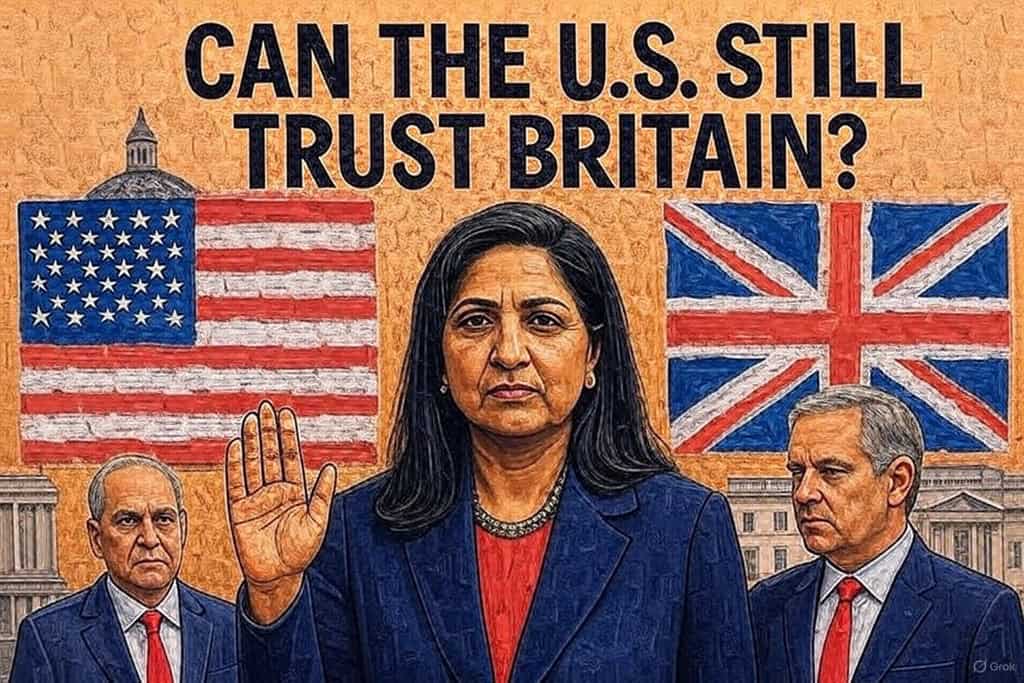
The United States faces a profound national security threat when foreign nations, particularly those traditionally aligned with Western interests, begin to fall under significant influence from Islamist actors or ideologies. Such influence can reshape foreign policy priorities, weaken intelligence and counterterrorism cooperation, and create safe havens for extremist networks that directly or indirectly target American interests.
Moreover, when allied governments adopt policies that tolerate or accommodate radical Islamist movements, the United States may find itself strategically isolated, compelled to confront threats without the support of partners it historically relied upon. This erosion of reliable alliances not only undermines collective security efforts but also increases the risk that extremist agendas gain a foothold in regions critical to global stability and U.S. national defense.
As long as I can remember, the United States and the United Kingdom have shared what our political leadership often describe as a “special relationship” — a partnership rooted in mutual sacrifice, shared democratic values, and the defense of Western civilization. But recent developments in British politics raise a pressing question: can America still count on Britain as a trustworthy ally?
Changing Leadership, Shifting Priorities
The foundation of any alliance is trust. Historically, United States and United Kingdom cooperation has been guided by a commitment to shared ideals and strategic security interests. Today, however, Britain is led by figures whose policies and rhetoric appear to challenge traditional norms and values. Some critics argue that these leaders not only undermine traditional British institutions but also enable extremist ideologies, the release of convicted criminals including ideological terrorists, and prioritize political correctness and multiculturalism over national security.
The United States must ask: is it time to reassess whether London remains aligned with American interests — or if it is drifting toward a path fundamentally at odds with Western democracy?
The “Five Eyes” Alliance Under Scrutiny
This week, the “Five Eyes” intelligence alliance — comprising the U.S., UK, Canada, Australia, and New Zealand — convened in London to address human smuggling and drug trafficking. The meetings were chaired by Prime Minister Keir Starmer’s newly appointed Home Secretary, Shabana Mahmood, who took her parliamentary oath on the Quran and has publicly stated that her Muslim faith is “the absolute driver of everything that I do.”
Soon after assuming office, Mahmood announced plans to release thousands of prisoners early to prevent what she described as a “total collapse” of the prison system, a move that raises concerns about public safety and the rule of law in Britain.
Controversial Statements and Allegiances
Mahmood’s rhetoric has sparked alarm among observers. She has repeatedly criticized Israel, echoed Hamas talking points about “bombing hospitals and schools,” and spoken at rallies calling for a “global intifada.” At one event, she urged attendees to “let out a mighty roar” until Palestinians are freed. Such statements suggest alignment with radical causes and raise questions about whether Britain’s top domestic security official can be relied upon to collaborate fully with American intelligence.
One widely shared video even shows Mahmood dismissing English flag-wavers as “white, male, and bad people.” For a nation’s chief domestic security officer to openly denigrate segments of her own citizenry undermines the credibility and moral authority essential to international cooperation.
The Erosion of Justice and Rule of Law
Ordinary British citizens face arrest for posting “offensive” content online, while migrants accused of violent crimes are sometimes released without consequence. This perceived double standard of justice is corrosive, eroding the principles that once underpinned the U.S.-UK partnership. Alliances are built on shared assumptions — truth, accountability, and a commitment to defend Western civilization. When these assumptions fail, trust becomes impossible.
Bottom Line
The bond between America and Britain has never been unconditional. In moments when allies’ actions contradict shared values or compromise national security, reassessment is necessary. For policymakers in Washington, the key question is not simply whether Britain remains a partner, but whether it can still be trusted to uphold the principles and responsibilities that once made the “special relationship” indispensable.
How the U.S. should recalibrate alliances when traditional partners are perceived as unreliable. It’s not necessarily about cutting ties, but about hedging, strengthening partnerships with more predictable allies, and reassessing shared commitments.
We are so screwed as the Islamists, funded with American oil profits, continue to infiltrate the West.
— Steve