Why trans issues have become a linchpin in contemporary cultural and electoral battles
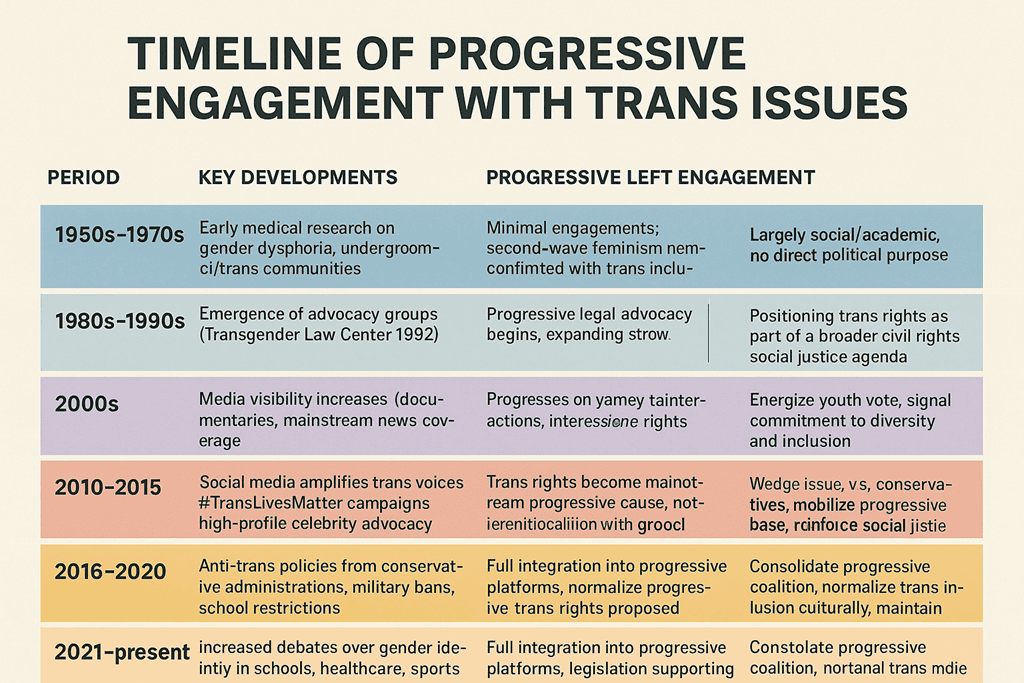
Transgender issues have gone from niche medical discussions to central talking points in media, schools, and politics. While some of this reflects genuine struggles, the progressive left has strategically amplified these narratives, turning trans issues into a cultural and political lever.
The Psychological Angle: Understanding Gender Dysphoria
Gender dysphoria is real—recognized by medical authorities as the distress caused by a mismatch between one’s biological sex and gender identity. It can include anxiety, depression, and profound social discomfort.
However, there’s a crucial nuance: while the distress is real, the underlying causes are complex, involving both psychological and possibly neurological factors. Medical treatment often focuses on alleviating suffering rather than “curing” identity—but progressives increasingly frame gender dysphoria as an identity to be fully affirmed at any cost, often extending this approach to children and adolescents. Critics argue that this risks pathologizing normal developmental exploration and pressures society into rapid, uncritical acceptance.
The Political Dimension: Amplification and Leverage
-
Moral Signaling: Progressive leaders and media outlets prominently feature transgender stories, often portraying these struggles as urgent moral crises. This elevates their own moral authority while casting critics as intolerant bigots.
-
Electoral Strategy: By championing trans rights, progressives appeal to young, urban, socially liberal voters. Policies on gender-affirming care, pronouns in schools, and anti-discrimination laws become not just social initiatives but vote-driving issues.
-
Cultural Control: Schools, corporations, and media increasingly enforce inclusive language, pronouns, and policies. Critics describe this as a form of “forced acceptance,” where societal pressure overrides debate or nuance.
-
Identity Politics: Trans issues are part of a wider push to define political loyalty through identity rather than shared policy outcomes. Supporting trans rights signals alignment with progressive values, reinforcing coalition cohesion.
-
Forced Acceptance: Social and Cultural Pressures
The push for total affirmation can clash with free speech, parental rights, and medical caution. Policies and media messaging often frame disagreement as intolerance, creating a culture where questioning the ideology is socially risky. This raises difficult questions: Should society fully normalize experimental or non-traditional identities in all contexts, or balance affirmation with critical oversight? Should society convey protected class status to transgender individuals with legal punishments for disrespect or disavowal? How does this conflict with First Amendment issues involving religion and the right of association?
Bottom Line
Transgender advocacy intersects with real mental illness involving psychological distress, but it is also entwined with strategic political amplification. Understanding both the human and the political dimensions is essential to navigating this contentious, fast-moving cultural debate.
There are valid arguments suggesting that the progressives’ emphasis on trans issues is disproportionate relative to population size, and exaggerates the political weight of a relatively small population, prioritizing political signaling over nuanced healthcare or education policy. Others highlight significant tensions with religious, parental, or free speech concerns.
There is little doubt that transgenderism polarizes debates, pressures schools to ignore parental rights, and forces corporations to adopt progressive norms, which often sideline nuanced medical or social discussions in favor of ideological signaling.
For many who experience gender dysphoria, transgender advocacy is genuine, but the progressive left has also amplified it strategically beyond any rational benefit to the greater society.
My philosophy is simple, “Live and let live, don’t bother me with your delusions.”
We are so screwed.
— Steve