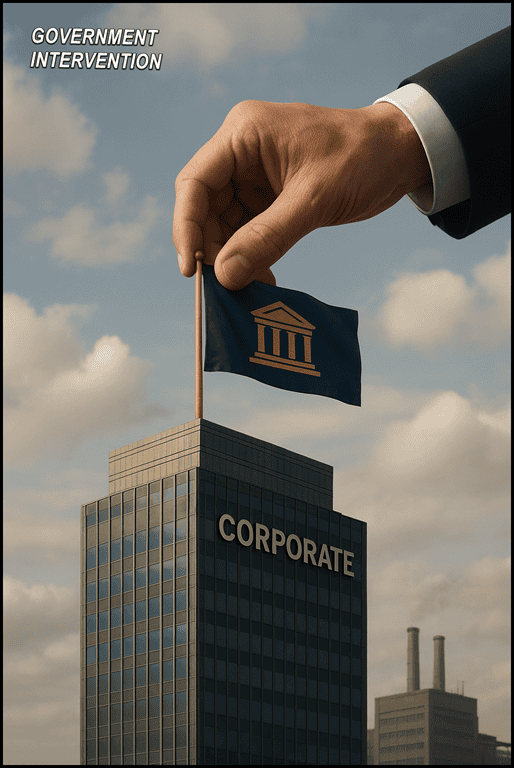
 For decades, the United States has prided itself on being the global champion of free-market capitalism. The promise of that system is simple: private enterprise succeeds or fails based on merit, innovation, and consumer demand.
Government, in theory, sets the rules of the game but doesn’t play on the field. Yet, in recent years, we’ve seen a growing trend of government stepping beyond regulation and loans, and into outright ownership stakes in strategic private corporations. That shift raises a fundamental question: are we drifting toward corporatism—and even toward elements of fascism—at the expense of free-market capitalism?
Loans vs. Equity: A Crucial Distinction
It’s one thing for governments to provide emergency loans. Loans keep the distinction clear: the company is still owned and managed privately, and the government expects to be repaid. In times of crisis—say, a financial collapse or pandemic-induced shutdown—loans can act as a bridge until normalcy returns.
Equity stakes are another matter entirely. When the government purchases shares, it isn’t simply helping from the sidelines. It becomes a co-owner, with the potential to exert influence over board decisions, strategy, and management. Unlike loans, equity does not expire. Even if the initial intent is to sell those shares once stability returns, the temptation for government to linger—and to use its new role for political leverage—is strong.
Fascism and the Corporatist Model
It’s important to be precise with terms. Fascism, historically, didn’t always mean outright state ownership of industry. Mussolini’s Italy, for example, retained private property and corporate ownership, but those corporations were closely coordinated, directed, and subordinated to the goals of the state. This is corporatism: the outward form of private enterprise coupled with an inner reality of political control.
In this sense, large-scale government equity stakes in “strategic” industries inch us closer to corporatism. If private companies no longer succeed or fail on their own, but instead survive through government partnership, the free-market dynamic of competition, risk, and reward is replaced with political calculation. Winners and losers are no longer chosen by consumers, but by bureaucrats and politicians.
The Risks of State Ownership
There are real dangers in normalizing government ownership in private firms:
- Market distortion – State-backed firms may receive subsidies, protection, or implicit guarantees that allow them to outlast competitors unfairly. Smaller, purely private firms get squeezed out.
- Bureaucratic inefficiency – Government managers rarely operate with the same incentive structure as private managers. Decisions may prioritize political goals—jobs in key districts, environmental optics, union votes—over efficiency, innovation, or profitability.
- Cronyism and corruption – Equity stakes can open the door to favoritism. Politically connected firms may get bailouts, while others are left to fail. Public resources end up underwriting private influence.
- Moral hazard – If companies believe government will step in with equity purchases whenever things get rough, they may take greater risks, confident they’ll be shielded from the consequences.
Why Governments Do It
Of course, the story isn’t entirely one-sided. Governments have reasons for stepping into equity roles.
Crisis management: In the 2008 financial meltdown, the U.S. government purchased equity in several banks and automakers. Supporters argue this prevented a full-scale collapse and, in some cases, taxpayers even profited when shares were later sold.
Strategic industries: Defense, energy, and telecommunications are often framed as too important to national security to leave entirely in private hands. Equity stakes can be sold as safeguarding sovereignty.
Public return: Unlike loans, equity can generate dividends or capital gains for taxpayers—if the companies thrive.
The issue is not that government never has a rationale. It’s that rationales tend to multiply and persist long after the emergency has passed. Temporary measures quietly become permanent footholds.
The Slippery Slope
One bailout may not end capitalism. But patterns matter. If more and more sectors—from finance to manufacturing to tech—begin to operate with implicit or explicit government ownership, the economy slowly morphs into something different. Competition weakens, innovation slows, and entrepreneurs think less about meeting consumer demand and more about currying favor with regulators and politicians.
At that point, the system is no longer one of free enterprise but of managed corporatism: nominally private ownership shaped, cushioned, and directed by the state. That is precisely the economic model that underpinned many 20th-century authoritarian regimes.
Guardrails for a Free Market
The challenge, then, is balance. Governments may need tools to prevent systemic collapse or protect vital national interests. But these tools must come with clear limits:
- Strict exit plans for equity purchases, with transparent timelines for divestment.
- Narrow definitions of what qualifies as “strategic” to prevent mission creep.
- Robust oversight to ensure that equity stakes are managed for taxpayer benefit, not political patronage.
- Renewed commitment to letting businesses fail when they cannot survive on their own merits.
Bottom Line
The health of a free market depends on keeping the roles of government and business distinct. Loans in emergencies may be defensible. Equity stakes, however, blur the line between regulator and owner, inviting inefficiency, distortion, and political meddling. Left unchecked, this trend nudges us away from competitive capitalism and toward corporatism, where success depends less on innovation and more on government favor.
The real danger is not a single bailout or equity purchase. It is the slow normalization of government as shareholder, creeping toward an economic order where private property exists in name only, and the free market becomes little more than a managed illusion.
We are so screwed.
— Steve