Climate change may be the only debate where questioning the narrative is treated like heresy. We’re told the “science is settled,” yet real science is never settled—it thrives on doubt, challenge, and discovery. Instead of honest debate, we get alarmist headlines, cherry-picked data, and political spin dressed up as fact. Climate skepticism isn’t denial—it’s refusing to accept fearmongering and profit-driven agendas as a substitute for evidence.
Politicians
Politicians have a unique talent for turning a simple question into a masterclass in word salad.
They dodge, weave, and spin like Olympic gymnasts, delivering speeches that sound impressive but say absolutely nothing. Their motto: “If you can’t dazzle them with facts, baffle them with bullshit.”
They’ll promise every citizen the moon, the stars, and a puppy—then deliver a parking ticket and call it progress. It’s a well-rehearsed dance of doublespeak, where the only thing clearer than their intentions is the smoke they’re blowing up your ass.
They cannot be trusted when it comes to putting aside their own self-interests and those of the special interests that support them.
Researchers
Climate researchers often practice a kind of selective honesty when it comes to funding. They highlight findings that align neatly with the priorities of grant sponsors, while quietly shelving results that don’t support the prevailing narrative. After all, careers, reputations, and entire institutions depend on a steady stream of climate dollars. This creates a feedback loop where researchers tell funders what they want to hear, bureaucrats endorse conclusions that match their agendas, and the cycle of “approved science” keeps the money flowing—truth optional.
Media
Media outlets thrive on fear because fear sells. By amplifying extreme climate projections, they grab attention, drive clicks, and boost ratings—all while posing as guardians of truth. Balanced reporting doesn’t move the needle, but apocalyptic headlines do, so nuance gets buried under a steady drumbeat of catastrophe. In the end, the media isn’t informing the public—it’s monetizing panic.
Weather vs. Climate
Weather refers to short-term atmospheric conditions in a specific place—temperature, humidity, rainfall, and wind over hours or days. Climate describes long-term patterns and averages of weather over decades, centuries, or even millennia.
The weather is constantly changing, of course. Summers get labeled “global warming,” winters are “global cooling,” and moderate spring or fall conditions are “global pauses.” Also “global climate change.” Any weather that causes discomfort or damage is deemed “extreme.” But short-term weather impacts have little to do with global climate as measured over the millennia.
Infallible Arguments
An infallible argument is one so absolute that no evidence can dispute it. It’s unchallengeable, airtight, and apparently perfect.
Science, however, doesn’t work that way. It’s inherently a process of testing, questioning, and refining ideas. Even well-established theories are always open to revision. Scientific knowledge is provisional, self-correcting, and adaptable. There is no such thing as an infallible scientific argument.
Moreover, the science is never settled and is not performed by consensus. When Albert Einstein published his theory of relativity, a book was later released titled “One Hundred Authors Against Einstein.” His response cut straight to the point: “If I were wrong, one would have been enough.” Science is not determined by consensus or headcounts—it advances by evidence, not popularity contests.
The Truth About Global Climate Change (As of Today)
-
Humans cannot directly isolate or measure their impact on climate due to climate’s natural variability and cyclic nature. Thus, the use deeply flawed models, which they accept as gospel.
-
Humans cannot determine an “optimal” global temperature for life across the planet given the range of climate bands between equatorial latitudes and the polar regions..
-
Carbon dioxide is essential for life, not a pollutant, and has limited impact on climate outside flawed models.
-
The significant drivers of climate change are the Sun’s energy output in all spectral bands, cosmic ray production, the Earth’s position relative to the Sun, the Earth’s rotational and precessional dynamics, plate tectonics and vulcanology, deep ocean currents, and the most significant greenhouse gas: water vapor.. These factors are beyond human control.
-
No public policy, initiative, or tax has demonstrably changed weather or climate.
- Politicians and their special interest supporters have accumulated wealth and power at humanity’s expense.
-
Researchers follow funding incentives, selecting projects that align with sponsors’ philosophies. Bureaucrats reinforce their superiors’ positions—creating a self-fulfilling narrative that humans are the main problem.
Media outlets profit from extreme projections that attract clicks and enlarge audiences.
Bottom Line
In short, the profitable climate narrative is heavily incentivized to continue, regardless of its scientific validity.
How did they ignore their own numbers?
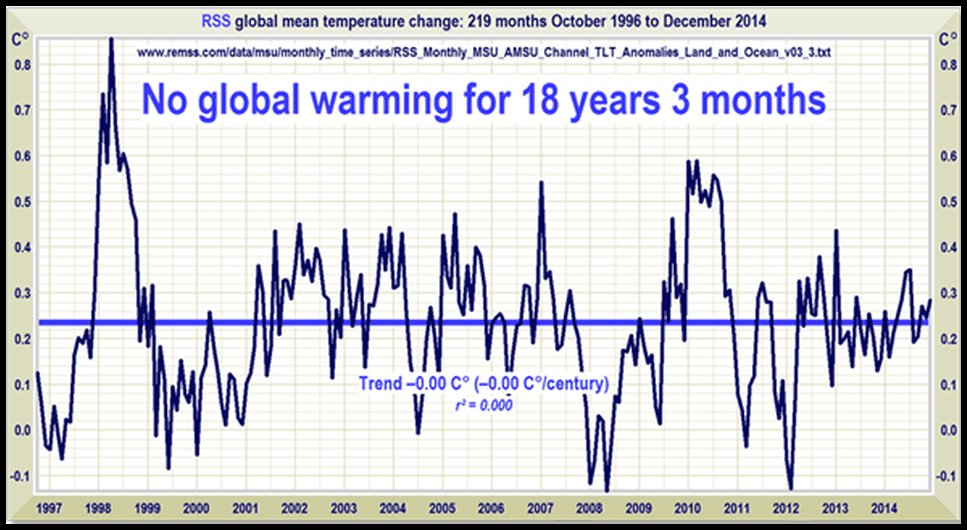
We are so screwed.
— Steve