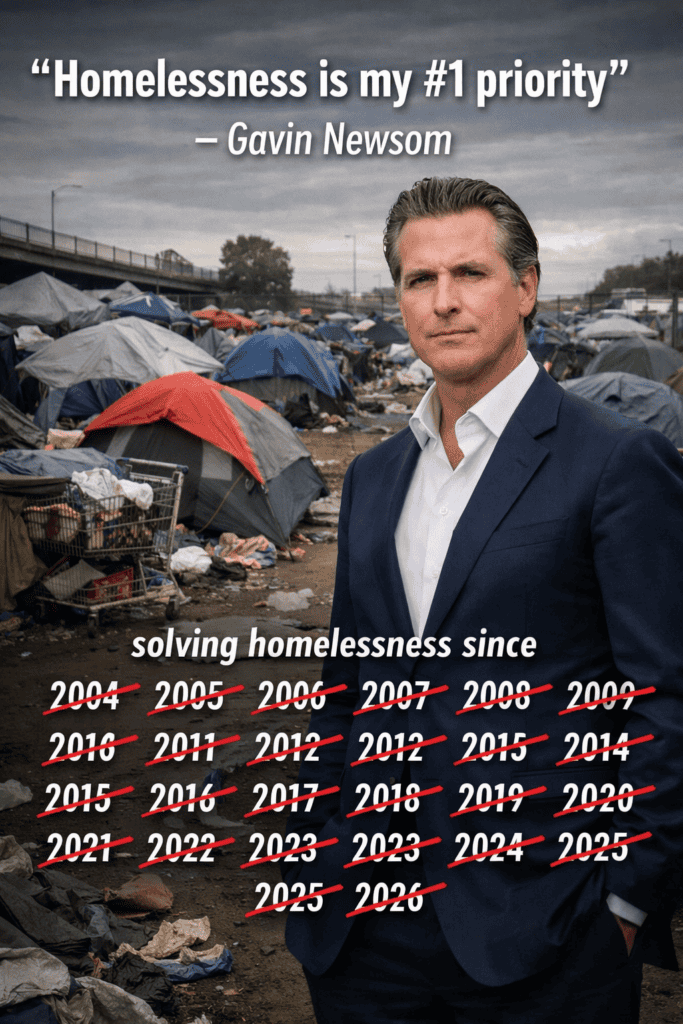
The California Experiment That Became A National Warning.
For more than twenty years, Gavin Newsom has promised to solve homelessness.
- He made the pledge as mayor of San Francisco.
- He repeated it as lieutenant governor.
- He elevated it to a top statewide priority after becoming governor.
And now, after presiding over the most expensive homelessness response in American history, the same politician is floating himself as a national leader ready to apply the “California Model” to the entire United States.
That should terrify anyone paying attention.
Because the California model has produced one unmistakable result: more spending, more bureaucracy, and more homelessness.
Twenty Years Of Promises
Newsom’s rhetoric about homelessness has been remarkably consistent.
In 2003, as mayor-elect of San Francisco, he declared: “Ending chronic homelessness will be a top priority of my administration.”
As governor, he again elevated the issue to the center of his agenda, insisting: “No one in our nation should be without a place to call home.”
In the 2020 State of the State address, he doubled down: “We must do everything we can to ensure no Californian is homeless.”
And recently he claimed: “We’re breaking cycles of homelessness that took decades to create.”
Two decades of promises.
Two decades of escalating spending.
And the crisis has only gotten worse.
$24 Billion Later—Where Did The Money Go?
Between 2018 and 2023, California allocated roughly $24 billion toward homelessness programs.
That money flowed through:
- 9 separate state agencies
- More than 30 different programs
- Thousands of grants to cities, counties, nonprofits, and housing developers
The spending covered everything imaginable—shelters, permanent supportive housing, motel purchases, encampment cleanups, rental assistance, outreach teams, and mental-health services.
In theory, it should have produced dramatic results.
Instead, it produced confusion.
The Audit That Exposed Newsom’s Leadership Failure
A 2024 California State Auditor report delivered a devastating conclusion.
Despite spending tens of billions of dollars, the state often cannot clearly show whether the programs worked.
The problems were structural:
- No centralized system tracking homelessness spending
- Agencies collecting incompatible data
- Programs measuring money spent rather than outcomes achieved
- Cases where the state lost track of individuals who received services
This isn’t just bureaucratic sloppiness.
It is a failure of leadership at the highest level of government.
When billions are spent without a clear system to measure results, that is not a policy mistake—it is a management collapse.
The Political Industry Built Around Homelessness
Massive government spending tends to create powerful interest groups, and California’s homelessness system is no exception.
The billions flowed through an enormous network that included:
- Politically connected housing developers
- Non-governmental organizations
- Consultants and lobbyists
- Government agencies
- Unionized construction contractors
One of the biggest cost drivers has been the construction of permanent supportive housing, where units routinely cost extraordinary sums.
Examples frequently cited in oversight hearings include:
- Los Angeles projects costing $500,000 to $700,000 per apartment
- San Francisco developments reaching $800,000 to over $1 million per unit
By the time land, permitting, union labor, environmental reviews, and service contracts are included, these units sometimes cost more than luxury housing in other parts of the country.
The system rewards spending, not speed or results.
Oversight Failures At The Local Level
Much of the money flows from the state to local agencies and nonprofit organizations, where oversight becomes even weaker.
Audits have uncovered serious problems with record-keeping and contract monitoring.
One of the most scrutinized agencies is the Los Angeles Homeless Services Authority, which distributes billions in funding across Los Angeles County.
Investigations found issues such as:
- Poor documentation of spending
- Weak oversight of contractors
- Difficulty verifying services actually delivered
- Lack of clear performance metrics
The problems became so severe that some local leaders proposed removing control of homelessness programs from the agency entirely.
Expensive Programs With Uncertain Results
California’s homelessness spending has funded a long list of programs:
- Encampment cleanup grants
- Temporary motel housing
- Outreach teams
- Permanent supportive housing construction
- Rental subsidies
- Hotel purchases under Project Homekey
One encampment resolution program alone received nearly $900 million.
Project Homekey has spent more than $3.7 billion to purchase hotels and convert them into housing.
Supporters say these programs provide shelter quickly.
Critics point out that many projects require enormous renovation costs and ongoing subsidies for decades.
And once again, auditors found that the state often failed to track whether people placed into temporary housing remained housed long-term.
Meanwhile, The Crisis Grew
Despite the massive spending surge, California’s homeless population continued rising during much of the same period.
Between 2018 and 2023:
- Roughly $24 billion was spent
- The homeless population increased by about 32%
- California now accounts for roughly one-third of the homeless population in the entire United States.
- The tents lining sidewalks in Los Angeles, San Francisco, and other cities have become an international symbol of government failure.
Leadership Means Accountability
Every governor inherits problems.
But leadership is measured by results and accountability.
After two decades of promises and billions in spending, California still cannot answer basic questions about its homelessness programs:
- Where exactly did the money go?
- Which programs worked?
- Which programs failed?
- How many people actually moved from the streets into permanent housing?
When a government cannot answer those questions after spending tens of billions of dollars, the issue is no longer policy—it is leadership.
And Now He Wants To Run The Country
Despite the results in California, Gavin Newsom is increasingly positioning himself as a national political figure and potential presidential contender.
His pitch is that California represents a forward-looking model for the rest of the country.
But if the homelessness crisis is any indication, the “California Model” looks less like a solution and more like a warning.
Because exporting the same policies nationwide would mean exporting the same system:
- Massive spending.
- Fragmented bureaucracy.
- Weak oversight.
- And uncertain results.
Bottom Line
California’s homelessness crisis is not merely a complex social challenge—it is a test of political leadership.
Under Gavin Newsom’s watch, the state spent roughly $24 billion on homelessness programs spread across dozens of agencies and initiatives. Yet audits repeatedly found weak oversight, fragmented management, and an inability to track outcomes clearly.
The result has been rising costs, expanding bureaucracy, and a crisis that continues to dominate California’s streets.
Before anyone considers applying the “California Model” to the entire nation, they should first examine the results it produced at home.
Because leadership is not defined by speeches or ambitions for higher office.
It is defined by results.
And the results in California speak for themselves.
To Gavin Newsom: No, thank you. Fuck you very much.
— Steve